On our second day in Riga, after our visit with the travel agent to the embassy to get our visas, we went to walk around old town Riga. What an amazing walk it was – almost like going back in time with cobblestone streets and walkways and narrow avenues, large courtyards and quaint buildings that made us feel we were back in another age. There were a lot of visitors there site seeing along with us.
First stop was the Freedom monument just a few blocks from our motel and at the entrance to old town Riga.
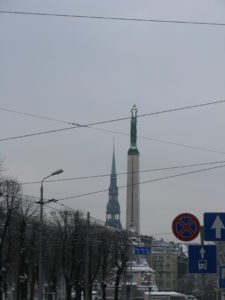
Here is a view of the monument from about a block away.
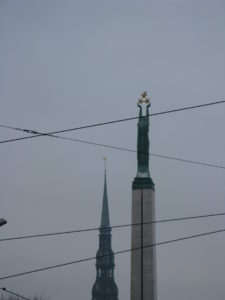
Here is a close up of the monument. It is a copper figure of Liberty lifting three gilded stars.
The Freedom Monument is a memorial located in Riga, Latvia, honoring soldiers killed during the Latvian War of Independence. It is considered an important symbol of the freedom, independence, and sovereignty of Latvia and is often the gathering place of important ceremonies, government and other.
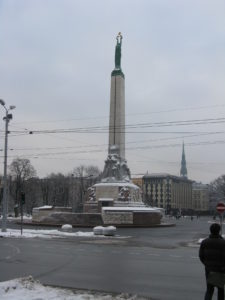
Base of the Freedom Monument on one side.
The sculptures and bas-reliefs of the monument, arranged in thirteen groups, depict Latvian culture and history. The core of the monument is composed of tetragonal shapes on top of each other, decreasing in size towards the top, completed by a 19-metre (62 ft) high travertine column bearing the copper figure of Liberty lifting three gilded stars. The concept for the monument first emerged in the early 1920s when the Latvian Prime Minister, Zigfr?ds Anna Meierovics, ordered rules to be drawn up for a contest for designs of a “memorial column”. After several contests the monument was finally built at the beginning of the 1930s according to the scheme “Shine like a star!” submitted by Latvian sculptor K?rlis Z?le. Construction works were financed by private donations.
Following the Soviet occupation of Latvia in 1940 Latvia was annexed by the Soviet Union and the Freedom Monument was considered for demolition, but no such move was carried out. Soviet sculptor Vera Mukhina is sometimes credited for rescuing the monument, because she considered it to be of high artistic value. Soviet propaganda attempted to alter the symbolic meaning of the monument to better fit with Communist ideology, but it remained a symbol of national independence to the general public. Indeed, on June 14, 1987, about 5,000 people gathered at the monument to commemorate the victims of the Soviet regime and to lay flowers. This rally renewed the national independence movement, which culminated three years later in the re-establishment of Latvian sovereignty after the fall of the Soviet regime.

The guards standing at attention at the base of the monument. The have on warm coats and hats but their faces and ears are not covered – made us cold to see them.
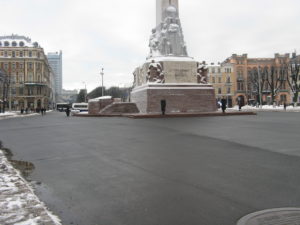
Details of this side of the monument.
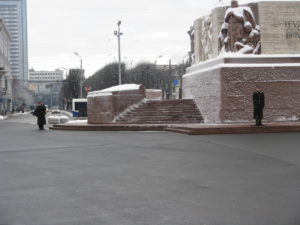
Notice on the left the soldiers coming out for the changing of the guard. We were there at a great time.
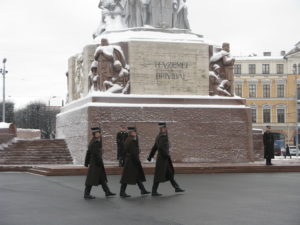
Marching in great precision the new guards come out.
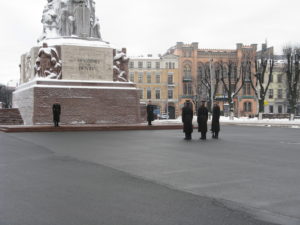
They salute and prepare to change.
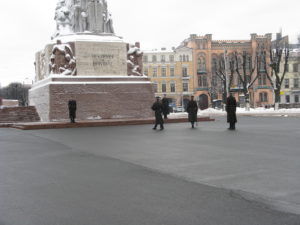
The new guards march forward to meet the guards they are replacing.
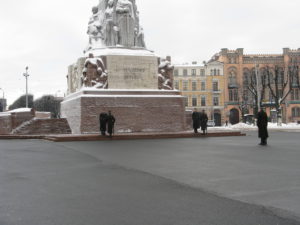
They salute each other.
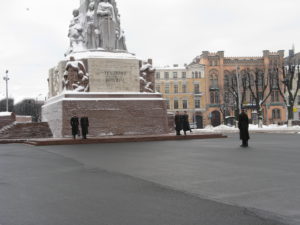
They change places.
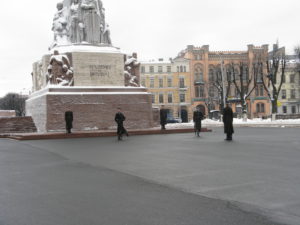
The cold guards move back to their leader and prepare to leave.
We felt such reverence for this experience. It was much like watching the changing of the guard at Arlington National Cemetery. The difference was since this is in the midst of a very busy city most people just ignored it almost as if it wasn’t happening at all. Unlike Arlington National Cemetery where you choose to go there just to see it, this is just part of every day life and life goes on around it all the time.
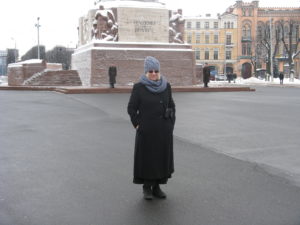
Me in front of the monument. Notice my nice new hat which is fleece lined and very warm and a good complement to my great scarf that I can put over my head and around my neck or just around my neck.

Walking toward old town away from the monument is this very strange clock which is supposedly very famous. Not sure what it all means, but it was interesting. The building on the corner is one of many hotels in the city.
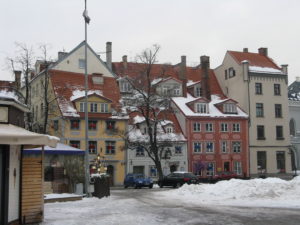
We loved these three houses all decked out with Christmas finery. They are a good sampling of the houses we saw all over the town. All unique and all different but reminiscent of the past. These houses are still occupied. Some houses have shops on the first floor and apartments upstairs, some are businesses, others are actual residences.
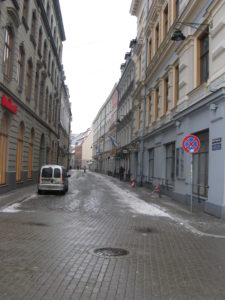
One of many narrow little streets. The car looks very out of place here.
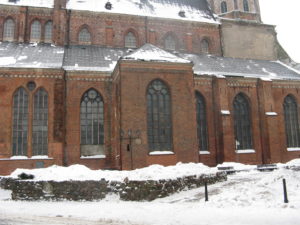
This is St. Peter’s Church – the oldest church in Riga. They say the oldest reference to it is in 1205 AD. It is a huge building with a very high steeple.
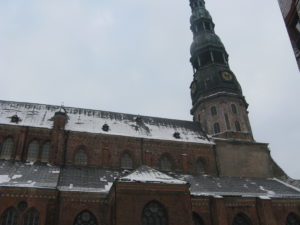
Another view of St. Peter’s Church
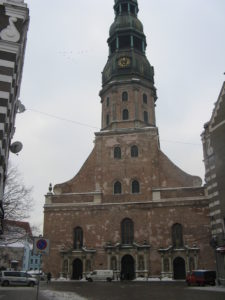
Another view of St. Peter’s Church

Another view of St. Peter’s Church. Unlike most of the churches in Riga this church is not for worshiping. It is being renovated and kind of a museum with a fee to go in and see it.
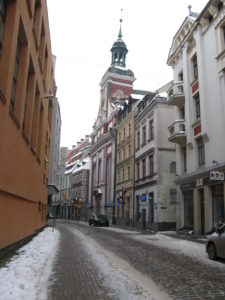
Here is another street with a steeple in the back ground to yet another church.
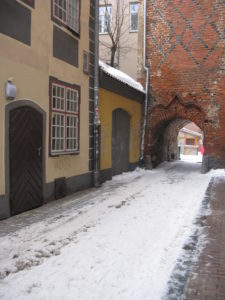
We went down a street we saw many people disappearing into the little opening. It seemed so quaint that we decided to look in and there were shops and a little tea house there. Cute.
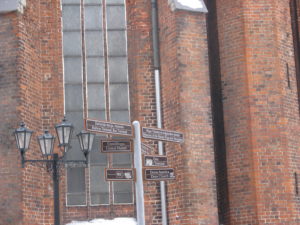
Living where we are we are often frustrated as most streets are not named so it is hard to get around. In Riga that is not the case. All the streets are named. This grouping of signs shows several streets converging.
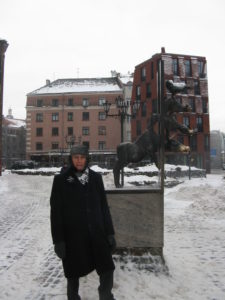
I loved the story of The Bremen Town Musicians when I was young and low and behold here in old town Riga is a statue to them. Carl is standing near it. It is kind of dark but there is definitely a donkey, a pig, a cat and a rooster. This is outside a church – interesting.
Before I go on I thought I would add a couple of outside things. First a great artists view of old town Riga and a couple of maps you might use to orient yourselves with my pictures. I hope they help you get a feel for where we went.
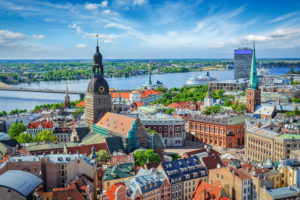
Artists view of old town Riga.
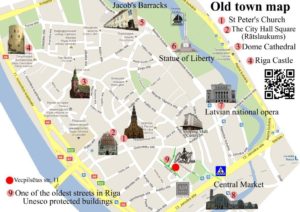
This map is not to scale but has several landmarks on it.
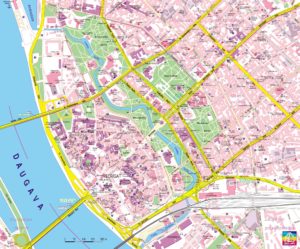
This map is more to scale. The blue is the large river Daugava. the green is a park system that is very large and I am sure very beautiful in the spring and summer. Even in winter it is very nice. Out hotel was on the right of the farthest right greenway. The middle yellow road going from the top right to the bottom left is the road we walked along to get into old town. The monument is just to the left of the second greenway which has a small river (perhaps creek is a better word) going through it.
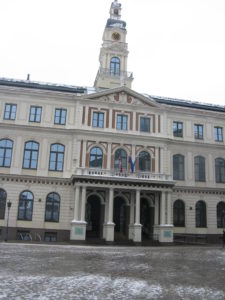
This is the Rigas Dome, a government building of some kind.
Name plate on the Rigas Dome.
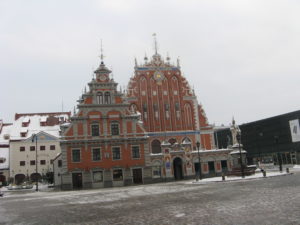
We were just wandering when we came upon the House of Blackheads. It was once the meeting place for the guild of unmarried German merchants. It is currently under renovations so we couldn’t go inside but it was amazing to see it from the outside. The clock is a masterpiece with four times on it (day, month, hour, minute).
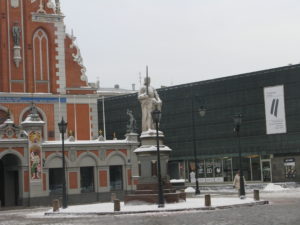
Statue in front of the House of Blackheads
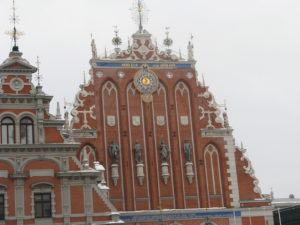
I hope you can see the clock a little better here.
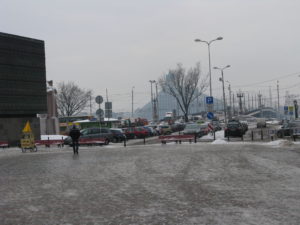
Going toward the river is one of the many bridges that cross the river.

This Statue to the fighting Soldiers looked very soviet to us but is it very Latvian.

A closer view of the Statue to the fighting Soldiers
So this is getting very long. I am going to close and add more, probably tomorrow.